ひがみストレート
◁
◂
勉強
◂
◁
第一話
英語
Blatant Jealousy
分析
ひがみ
ストレート
ひがみ
書き方:僻み
読み方:ひがみ
noun
1.
prejudice; bias; warped view; jealousy; inferiority complex
ストレート
読み方:ストレート
adjectival-noun
noun
1.
straight
adjectival-noun
noun
2.
straightforward; direct; straight out; blunt
adjectival-noun
noun
3.
neat (e.g. spirits); black (e.g. tea, coffee)
noun
4.
entering university directly from high school
noun
baseball
5.
fast ball; straight ball
noun
sports
6.
straight (boxing punch)
adjectival-noun
noun
7.
straight (as opposed to gay)
noun
8.
straight (in poker)
1コマ

とも
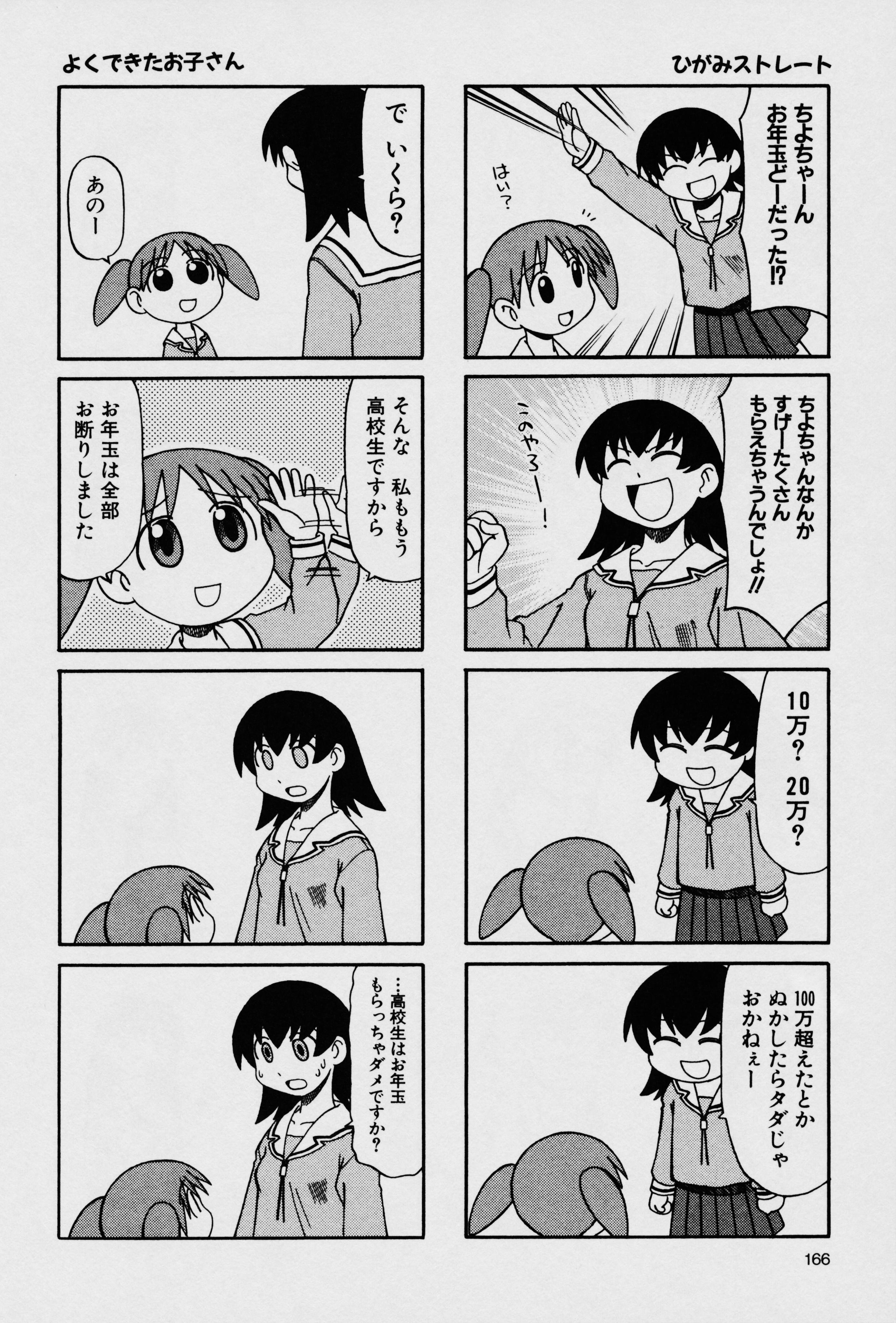
ちよちゃーん お年玉どーだった!?
英語
Chiyo! How'd you make out with your New Year's money!?
分析
ちよ
ちゃーん
お年玉
どー
だった
!
?
ちよ

名前:ちよ
苗字:美浜(みはま)
A genius girl who was able to transfer into highschool early.
ちゃーん
読み方:ちゃん
suffix
familiar
1.
suffix for familiar person
お年玉
書き方:お年玉
読み方:おとしだま
noun
1.
New Year's gift (usu. money given to a child by relatives and visitors)
どー
書き方:如何
読み方:どう
adverb
usually-kana
1.
how; in what way; how about
だった
読み方:だった
expression
1.
was
past tense of plain copula

ちよ
はい?
英語
Come again?
分析
はい
?
はい
読み方:はい
interjection
polite
1.
yes; that is correct
interjection
2.
understood; I see; OK; okay
interjection
3.
present; here
as a response to a roll call
interjection
colloquialism
4.
pardon?; what's that?; come again?
with rising intonation
interjection
5.
now; here; here you go
used when calling for someone's attention or when handing something to someone
interjection
6.
giddy-up; giddap
2コマ
とも
ちよちゃんなんかすげーたくさんもらえちゃうんでしょ!!
英語
Someone like you is bound to get loads of cash!!
分析
ちよ
ちゃん
なんか
すげー
たくさん
もらえちゃう
ん
でしょ
!
!
ちよ
名前:ちよ
苗字:美浜(みはま)
A genius girl who was able to transfer into highschool early.
ちゃん
読み方:ちゃん
suffix
familiar
1.
suffix for familiar person
なんか
読み方:なんか
particle
adverb
1.
something like ...; things like ...; someone like ...; the likes of ...
oft. scornful or dismissive
すげー
読み方:すげー, すげえ, すげぇ, すっげー
interjection
expression
colloquialism
1.
incredible; unbelievable; terrific; impressive
たくさん
書き方:沢山
読み方:たくさん
no-adjective
adjectival-noun
noun
adverb
usually-kana
1.
a lot; lots; plenty; many; a large number; much; a great deal; a good deal
no-adjective
adjectival-noun
noun
adverb
usually-kana
2.
enough; sufficient
noun-suffix
usually-kana
3.
enough; too many; too much
after a noun; usu. read as だくさん
もらえちゃう
書き方:貰う
読み方:もらう
活用形:potential chau non-past
godan-u-verb
transitive-verb
usually-kana
1.
to receive; to take; to accept
auxiliary-verb
godan-u-verb
usually-kana
2.
to get somebody to do something
follows a verb in "-te" form
godan-u-verb
transitive-verb
usually-kana
3.
to have in one's pocket (a fight, match)
godan-u-verb
transitive-verb
usually-kana
4.
to contract (a disease); to catch; to be affected
ん
読み方:ん
1.
oh!; good heavens!
2.
ugh!; oh no!
3.
ah!; the penny drops!
4.
yes!; okay!
5.
yes; yeah; uh huh
6.
huh?; what?
auxiliary-verb
suffix
7.
not
negative verb ending used in informal speech; abbr. of negative verb ending ぬ
particle
8.
's; of; belonging to
abbr. of particle の; indicates possessive
particle
9.
at (place, time); in; on; during
abbr. of particle に; used esp. when it precedes the verb なる
でしょ
読み方:でしょう, でしょ
expression
1.
it seems; I think; I guess; I wonder
expression
2.
right?; don't you agree?
このやろーー!
英語
You jerk!
分析
このやろーー
!
このやろーー
書き方:この野郎
読み方:このやろ
colloquialism
derogatory
1.
you bastard!; you son of a bitch!
3コマ
とも
10万?20万?
英語
100 thousand? 200 thousand?
分析
10万
?
20
万
?
10万
書き方:10万, 十万
読み方:じゅうまん
numeric
1.
100,000; hundred thousand
20
書き方:20, 二十
読み方:にじゅう
numeric
1.
twenty; 20
万
書き方:万
読み方:まん
numeric
1.
10,000; ten thousand
萬 is sometimes used in legal documents
noun
no-adjective
2.
myriad
noun
adverb
3.
everything; all
4コマ
とも
100万超えたとかぬかしたらタダじゃ おかねぇー
英語
If you brag that you got more than a million, I'll make you pay~
分析
100万
超えた
とか
ぬかしたら
タダ
じゃ
おかねぇー
100万
書き方:100万, 百万
読み方:ひゃくまん
numeric
1.
1,000,000; one million; million
noun
2.
many
超えた
書き方:越える, 超える
読み方:こえる
活用形:plain past
ichidan-verb
transitive-verb
1.
to cross over; to cross; to pass through; to pass over (out of); to go beyond; to go past
esp. 越える
ichidan-verb
transitive-verb
2.
to exceed; to surpass; to be more (than)
esp. 超える
とか
読み方:とか
particle
conjunction
1.
and the like; such as; among other things; and so on
oft. as ...とか...とか
expression
particle
2.
or something; something like; a (certain)
used to convey hearsay or uncertain information; oft. with 言う, 聞く, etc.
expression
particle
3.
I hear that ...; people say that...; rumour has it that ...
at sentence end
expression
particle
colloquialism
4.
or something; something like; or whatever
used to make a statement vague or less absolute; usu. after a noun
ぬかしたら
書き方:抜かす
読み方:ぬかす
活用形:conditional past
godan-su-verb
transitive-verb
1.
to omit; to leave out; to skip
godan-su-verb
transitive-verb
2.
to overtake; to pass
godan-su-verb
transitive-verb
vulgar
3.
to say; to speak
タダ
書き方:只, 唯
読み方:ただ
no-adjective
noun
usually-kana
1.
ordinary; common; usual
no-adjective
noun
usually-kana
2.
free of charge
only 只
no-adjective
noun
3.
unaffected; as is; safe
usu. as ただでは...
adverb
4.
only; merely; just; simply
conjunction
5.
but; however; nevertheless
esp. 但
じゃ
読み方:じゃあ, じゃ
conjunction
1.
then; well; so; well then
from では
copula
kansai
2.
be; is
おかねぇー
書き方:置く
読み方:おく
活用形:negative non-past
godan-ku-verb
transitive-verb
1.
to put; to place
godan-ku-verb
transitive-verb
2.
to leave (behind)
godan-ku-verb
transitive-verb
3.
to establish (an organization, a facility, a position, etc.); to set up
godan-ku-verb
transitive-verb
4.
to appoint (someone to a certain position); to hire; to employ
godan-ku-verb
transitive-verb
5.
to place (one's trust, one's faith, etc.); to bear (in mind, etc.)
godan-ku-verb
transitive-verb
6.
to put down a tool (e.g. a pen) hence stopping what one is doing with that tool
godan-ku-verb
transitive-verb
7.
to take in (boarders, etc.); to provide lodging in one's house
godan-ku-verb
transitive-verb
8.
to separate spatially or temporally
godan-ku-verb
auxiliary-verb
usually-kana
9.
to do something in advance
after the -te form of a verb
godan-ku-verb
auxiliary-verb
usually-kana
10.
to leave something in a certain state; to keep something in a certain state
after the -te form of a verb
第二話
よくできたお子さん
英語
A Well-Behaved Child
分析
よく
できた
お子さん
よく
書き方:良く, 能く
読み方:よく
adverb
usually-kana
1.
nicely; properly; well; skillfully; skilfully
adverb
usually-kana
2.
frequently; often
adverb
usually-kana
3.
I'm glad that you ...; thank you for ...
adverb
usually-kana
4.
(you have) quite the nerve to; I don't know how you can ...
できた
書き方:出来る
読み方:できる
活用形:plain past
ichidan-verb
intransitive-verb
usually-kana
1.
to be able (in a position) to do; to be up to the task
ichidan-verb
intransitive-verb
usually-kana
2.
to be ready; to be completed
ichidan-verb
intransitive-verb
usually-kana
3.
to be made; to be built
ichidan-verb
intransitive-verb
usually-kana
4.
to be good at; to be permitted (to do)
ichidan-verb
intransitive-verb
usually-kana
5.
to become intimate; to take up (with somebody)
ichidan-verb
intransitive-verb
usually-kana
6.
to grow; to be raised
ichidan-verb
intransitive-verb
usually-kana
7.
to become pregnant
お子さん
書き方:お子さん
読み方:おこさん
noun
honorific
1.
child
1コマ
とも
で いくら?
英語
So? How much?
分析
で
いくら
?
で
読み方:で, にて
particle
1.
at; in
indicates location of action; にて is the formal literary form
particle
2.
at; when
indicates time of action
particle
3.
by; with
indicates means of action
conjunction
4.
and then; so
auxiliary
5.
and; then
indicates continuing action; alternative form of 〜て used for some verb types
particle
kansai
6.
let me tell you; don't you know
at sentence-end; indicates certainty, emphasis, etc.
いくら
書き方:幾ら
読み方:いくら
noun
adverb
usually-kana
1.
how much
noun-suffix
usually-kana
2.
something over; and something; -odd
after a rounded number, esp. a sum of money
adverb
usually-kana
3.
however (much); no matter how
as いくら...〜ても, いくら...〜でも, etc.
ちよ
あのー
英語
Umm...
分析
あのー
あのー
読み方:あの, あのー
interjection
1.
say; well; um; er
2コマ
ちよ
そんな 私ももう高校生ですから
英語
No way, since I'm also already a high-school student.
分析
そんな
私
も
もう
高校生
ですから
そんな
読み方:そんな
prenoun-adjectival
1.
such; that sort of; that kind of; like that
about the actions of the listener, or about ideas expressed or understood by the listener
interjection
colloquialism
2.
no way!; never!
私
書き方:私
読み方:わたし
pronoun
1.
I; me
slightly formal or feminine
も
読み方:も
particle
1.
too; also; in addition; as well; (not) either (in a negative sentence)
particle
2.
both A and B; A as well as B; neither A nor B (in a negative sentence)
as AもBも
particle
3.
even; as much as; as many as; as far as; as long as; no less than; no fewer than
used for emphasis or to express absence of doubt regarding a quantity, etc.
particle
4.
even if; even though; although; in spite of
often as 〜ても, 〜でも, 〜とも, etc.
adverb
colloquialism
abbreviation
5.
further; more; again; another; the other
もう
読み方:もう
adverb
1.
now; soon; shortly; before long; presently
adverb
2.
already; yet; by now; (not) anymore
adverb
3.
further; more; again; another; the other
interjection
4.
tsk; dammit; jeez; come on; what the hell
used to strengthen expression of an emotion (often exasperation)
高校生
書き方:高校生
読み方:こうこうせい
noun
1.
senior high school student
ですから
読み方:ですから
conjunction
polite
1.
so; therefore; accordingly; consequently; on those grounds; that is why; for that reason
お年玉は全部お断りしました
英語
I declined all my New Year's money.
分析
お年玉
は
全部
お
断り
しました
お年玉
書き方:お年玉
読み方:おとしだま
noun
1.
New Year's gift (usu. money given to a child by relatives and visitors)
は
読み方:は
particle
1.
topic marker particle
pronounced わ in modern Japanese
particle
2.
indicates contrast with another option (stated or unstated)
particle
3.
adds emphasis
全部
書き方:全部
読み方:ぜんぶ
noun
no-adjective
adverb
1.
all; entire; whole; altogether
お
書き方:御
読み方:お
prefix
honorific
polite
humble
usually-kana
1.
honorific/polite/humble prefix
usu. before a term with a kun-yomi reading; おん is more formal
断り
書き方:断り
読み方:ことわり
noun
1.
notice; notification; warning
noun
2.
permission; consent
noun
3.
rejection; refusal; nonacceptance; declination; declining
noun
4.
excuse; plea
しました
書き方:為る
読み方:する
活用形:polite past
included-suru-verb
usually-kana
1.
to do; to carry out; to perform
included-suru-verb
usually-kana
2.
to cause to become; to make (into); to turn (into)
included-suru-verb
usually-kana
3.
to serve as; to act as; to work as
included-suru-verb
usually-kana
4.
to wear (clothes, a facial expression, etc.)
included-suru-verb
usually-kana
5.
to judge as being; to view as being; to think of as; to treat as; to use as
as 〜にする,〜とする
included-suru-verb
usually-kana
6.
to decide on; to choose
as 〜にする
included-suru-verb
intransitive-verb
usually-kana
7.
to be sensed (of a smell, noise, etc.)
as 〜がする
included-suru-verb
intransitive-verb
usually-kana
8.
to be (in a state, condition, etc.)
included-suru-verb
intransitive-verb
usually-kana
9.
to be worth; to cost
included-suru-verb
intransitive-verb
usually-kana
10.
to pass (of time); to elapse
included-suru-verb
transitive-verb
usually-kana
11.
to place, or raise, person A to a post or status B
as AをBにする
included-suru-verb
transitive-verb
usually-kana
12.
to transform A to B; to make A into B; to exchange A for B
as AをBにする
included-suru-verb
transitive-verb
usually-kana
13.
to make use of A for B; to view A as B; to handle A as if it were B
as AをBにする
included-suru-verb
transitive-verb
usually-kana
14.
to feel A about B
as AをBにする
suffix
included-suru-verb
usually-kana
15.
verbalizing suffix (applies to nouns noted in this dictionary with the part of speech "vs")
auxiliary-verb
included-suru-verb
usually-kana
16.
creates a humble verb (after a noun prefixed with "o" or "go")
auxiliary-verb
included-suru-verb
usually-kana
17.
to be just about to; to be just starting to; to try to; to attempt to
as 〜うとする,〜ようとする
3コマ
Empty Cell
4コマ
とも
…高校生はお年玉もらっちゃダメですか?
英語
...High school students don't get New Year's money?
分析
…
高校生
は
お年玉
もらっちゃ
ダメ
ですか
?
高校生
書き方:高校生
読み方:こうこうせい
noun
1.
senior high school student
は
読み方:は
particle
1.
topic marker particle
pronounced わ in modern Japanese
particle
2.
indicates contrast with another option (stated or unstated)
particle
3.
adds emphasis
お年玉
書き方:お年玉
読み方:おとしだま
noun
1.
New Year's gift (usu. money given to a child by relatives and visitors)
もらっちゃ
書き方:貰う
読み方:もらう
活用形:te-form
godan-u-verb
transitive-verb
usually-kana
1.
to receive; to take; to accept
auxiliary-verb
godan-u-verb
usually-kana
2.
to get somebody to do something
follows a verb in "-te" form
godan-u-verb
transitive-verb
usually-kana
3.
to have in one's pocket (a fight, match)
godan-u-verb
transitive-verb
usually-kana
4.
to contract (a disease); to catch; to be affected
ダメ
書き方:駄目
読み方:だめ, ダメ
adjectival-noun
noun
usually-kana
1.
no good; not serving its purpose; useless; broken
adjectival-noun
noun
usually-kana
2.
hopeless; wasted; in vain; purposeless
adjectival-noun
noun
usually-kana
3.
cannot; must not; not allowed
noun
4.
neutral point (in go); intersection owned by neither player at the end of a game
ですか
読み方:ですか
expression
polite
1.
indicates question
at sentence-end
Having trouble with the vocabulary?
Download the Azumanga Daioh Anki Deck!
It covers the posted translations, and is updated each time a new one is posted!
Download the Azumanga Daioh Anki Deck!
It covers the posted translations, and is updated each time a new one is posted!